browse by topics


In MTM - Made to Measure, architects Herzog & de Meuron have broken new ground for UniFor. Rather than creating a furniture system rooted in a particular context, the studio has instead designed an independent system that purposefully divests itself of a specific setting while still retaining its identity. “We live in an age obsessed with context,” writes Marco Maturo, one of UniFor’s art directors and a co-founder of Studio Klass. “Every object must declare its belonging, every project must express its place, every space must be immediately recognizable. But what happens when products don't belong to a specific place and, for this very reason, can belong to many?”
The story of MTM - Made to Measure is one of specific, purposeful design decisions that have been taken in order to free furniture from the constraint of specific contexts. “The strength of the MTM series lies in its versatility,” explains Ascan Mergenthaler, a senior partner at the Swiss architecture practice, who has designed the collection to range freely across tables, benches, sofas and more. While the collection may have begun life as a standing table for the architects’ Basel studio, it soon developed into a scalable system that could manifest across spaces of every kind. “Rather than being tailored to a single setting,” Mergenthaler notes, “it is designed, as its name suggests, to be made to measure in its actual use, physical dimensions, purpose, and its material quality.”
 Cork-clad elements. In the foreground, the bench; in the background, the single- and double-sided sofas | Ph. Alberto Strada
 Table-tennis table with solid oak frame | Ph. Alberto Strada
The MTM - Made to Measure collection consciously adapts itself across its individual elements. While the majority of the load-bearing structures are made from solid wood, one version of the table breaks from this logic and is instead made from mirror-polished stainless steel. Meanwhile, many of the tabletops modulate the collection into the use of travertine and coloured glass. Elsewhere, cork has been used to upholster the seating, providing sound dampening in addition to texture and tactility – “Each piece of cork has a life of its own,” Mergenthaler says, “its organic grain means no two elements are alike, and over time it absorbs traces of use, evolving with the furniture.” It is, in sum, a varied material palette, yet each piece is also united with those around it through a specific design detail: a precise 12° leg angle that is used within traditional woodworking to provide strength and stability, and which has also been echoed across the collection’s chamfered surfaces. It is a detail designed to bring harmony and a clear identity. “Every time you change the material at the centre of the frame, the look and feel of the piece is transformed,” Mergenthaler explains.
“From straightforward and simple to extraordinary and spectacular – it’s never neutral, it always carries a lot of character. Within the same construction principle, look and feel are completely different depending on the composition, materials and context, which is what keeps it from becoming generic.”
Underlying this adaptability, however, is precise engineering rigour. Working in conjunction with technical teams at UniFor, with whom the practice has collaborated for a number of years, the architects developed a structure that is adaptable across the range. Each piece within the MTM - Made to Measure collection is built around an understructure formed from four solid wood beams, which fit together in a system that offers what Mergenthaler terms “a contemporary adaptation of the traditional castle joint”. The effect is light and unobtrusive, allowing the MTM furniture to move easily between contexts, concealing a pre-tensioning system created using metal bars that allows the pieces to stretch to far larger spans than would be achievable in conventional wooden furniture, and which is also scalable. Herzog & de Meuron’s design allows the same basic structure to generate tables, benches and sofas of different lengths, with each element capable of being extended or resized without affecting the overall proportions or identity of the system.
 Table with mirror-polished steel frame | Ph. Alberto Strada
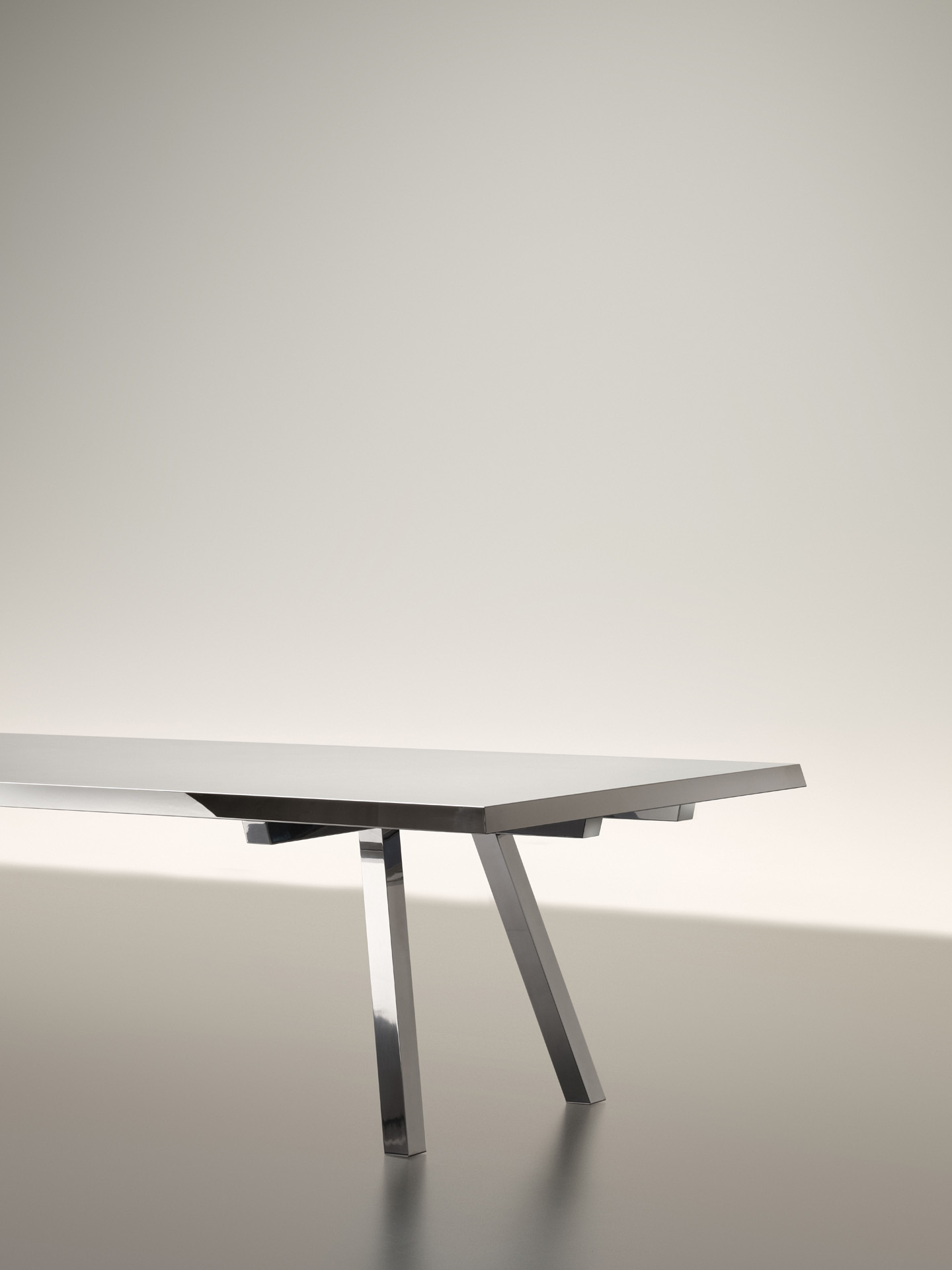 Table with mirror-polished steel frame | Ph. Alberto Strada
“This system allows each piece to scale up or down, lengthen or shorten, transforming from huge table to coffee table, sofa to bench, sideboard to console.”
“Today we often expect objects and spaces to clearly declare their context, but the Made to Measure collection seemed to resist this logic,” explains Maturo. This flexibility enables the collection to shapeshift between different spaces, atmospheres and applications. “It does not belong strictly to an office, a domestic space, or a specific typology. Instead, it behaves as an open grammar of elements capable of inhabiting multiple environments while maintaining their identity.”
 In the foreground: table with oak frame and travertine insert; in the background: table with oak frame and coloured glass insert | Ph. Alberto Strada
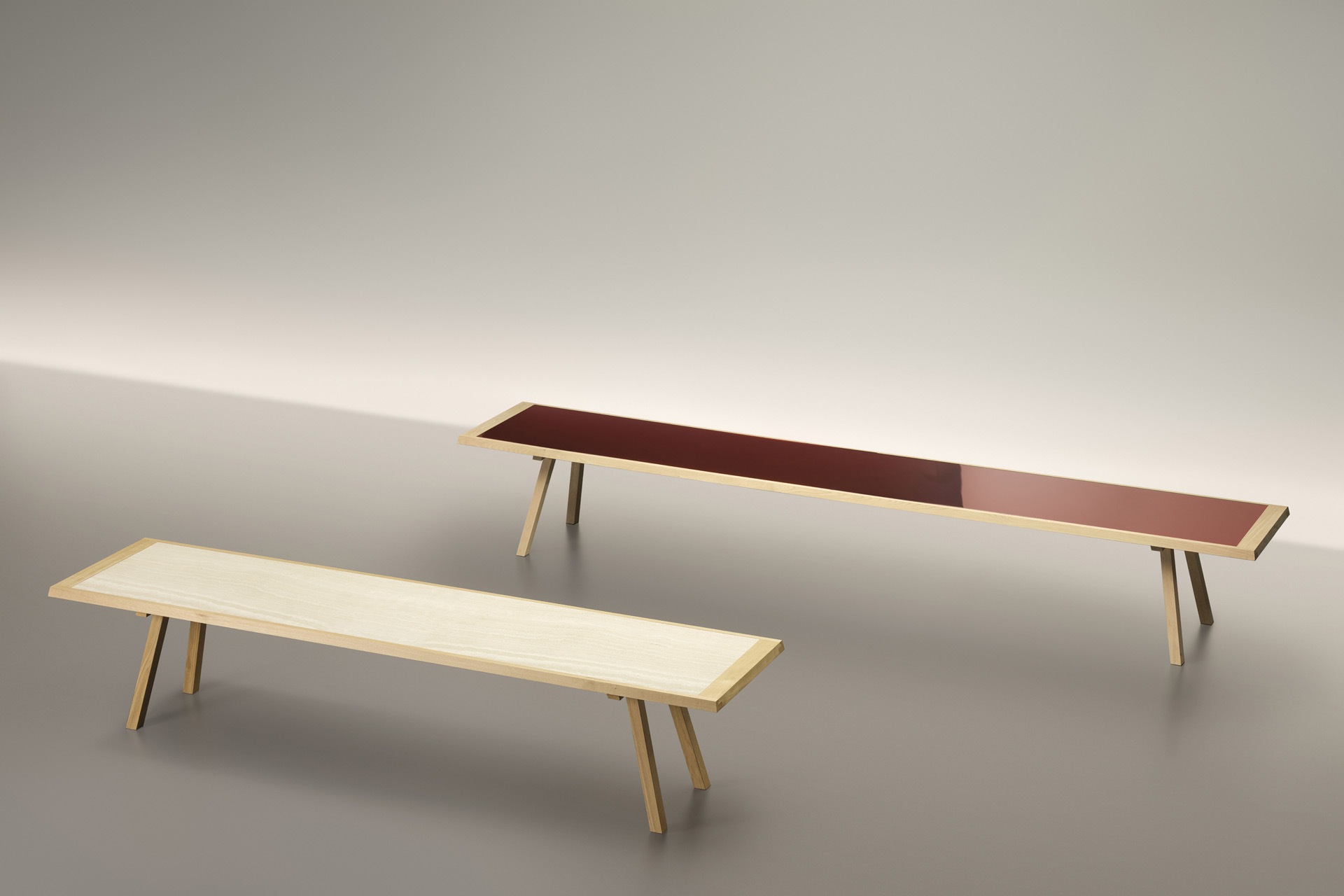 In the foreground: table with oak frame and travertine insert; in the background: table with oak frame and coloured glass insert | Ph. Alberto Strada
In this regard, MTM - Made to Measure continues themes that have been present throughout Herzog & de Meuron’s practice, ever since its foundation in 1978 by Jacques Herzog and Pierre de Meuron. While the studio has created celebrated architecture of every stripe – from the converted brick power station in which the Tate Modern (2020) was developed, to the fluid glass sweep of Hamburg's Elbphilharmonie (2017) or the steel nest encasing Beijing’s National Stadium (2008) – it has always resisted the reduction of its work to a singular style or approach. “One of the distinguishing characteristics of Herzog & de Meuron was that they had no house style,” noted Rowan Moore, architecture critic of The Observer in 2021. “Their buildings might be made of mud or steel or wood or concrete, and they could be square or round or multiform, or extravagant or austere, even though they somehow shared the same underlying attitudes.” It is an approach that Herzog, in dialogue with Moore, argued played into his own belief as to the purpose of architecture and design. “I always ask what contribution can you make?” he explained. “Making something iconic is easy but to make it in a more subtle way, in a more sustainable way, is more important.”
 In the foreground, square coffee table; in the background, cork-clad single-sided sofas | Ph. Alberto Strada
 Table-tennis table with solid oak frame | Ph. Alberto Strada
This is an approach that permeates all aspects of the MTM - Made to Measure design. In place of an aesthetic and function that is fixed and immutable, the MTM furniture ranges from demure cork benches that might line the walls of a reception or foyer, yet would be equally at home in a living room; extended tables that could facilitate collaboration or meetings in a workspace, yet which could also play host to family meals. The collection’s 12° is characterful but restrained, creating an air of elegance across the system, but MTM - Made to Measure is equally capable of more joyful or playful applications: one configuration of the system, for instance, manifests as a ping-pong table. All this has been made possible through the systematic approach adopted by Herzog & de Meuron in the design.
“From the large communal table to more compact configurations, through to the table tennis version, the constructive principle remains unchanged,” Mergenthaler notes. “It is a system designed to adapt and to encourage encounter.”

This sense of encounter will take centre stage in Non Places, UniFor’s installation curated by Studio Klass during the 2026 Milan Design Week, in which MTM - Made to Measure will be displayed within a burnt red space, whose floor is scored with white lines that seems to recall no fixed location: the lines may reference the markings on a sports court or urban plan (hinting at MTM’s own rigorous construction logic), but the umber earth seems interplanetary and alien. “A mineral, almost Martian surface. A primordial, abstract, suspended ground,” Maturo explains of the installation, which is built around a large glass cylinder at its centre, a design detail that, Maturo says, helps to define a boundary, while remaining transparent and observable, turning the space into something that feels “almost like an experiment or a hypothesis”. The intention is to invite viewers to interpret the relationship between objects and space freely, without being guided by a predefined narrative. This, however, is firmly within the spirit of the MTM project as a whole. “Choosing indeterminacy becomes a deliberate position,” Maturo explains. “It leaves room for interpretation and highlights the relationship between form, material, and space. In this suspended territory between architecture and product, the collection reveals its most universal dimension.”
Main Image: Overview of the MTM – Made To Measure collection by Herzog & de Meuron for UniFor.
Photograph: Alberto Strada
A century of sound, design, and memory explored through an elegant reflection on acoustics as an emotional and architectural experience, in the enduring spirit of Bang & Olufsen.
The Future Perfect’s David Alhadeff and ceramicist Carmen D’Apollonio guide us through the cultural hotspots of the city they call home: Los Angeles.
Porosity between the exterior and interior space defines contemporary luxury in a series of new developments that open up buildings to the great outdoors.


